Monday, 18 January 2016
Janani Janma Bhoomischa Swargadapi Gariyasi
Wednesday, 11 November 2015
Remembrance Day - Poppy Day.
People wear "Poppy flowers" on this day, as a synbol of sacrifices made by the soldiers in the wars."Scarlet corn poppies (popaver rhoeas) grow naturally in conditions of disturbed earth throughout Western Europe. The destruction brought by the Napoleonic wars of the early 19th Century transformed bare land into fields of blood red poppies, growing around the bodies of the fallen soldiers.
Saturday, 10 October 2015
DARA SHIKOH - THE ENLIGHTENED PRINCE
Prince Shahab ud-din Muhammad Khurram's (Mughal Emperor Shah Jahan) prayers at the Dargah of great Sufi mystic Hazarat Kwaja Moinuddin Hassan Chisti at Ajmer, for a male heir, was answered on Safar 19, 1024 AH (March 20, 1615 AD) by the birth of a male child to his beloved wife Arjumand Banu Begam (queen Mumtaz Mahal) at Sagartal near Ajmer. Grand father Emperor Jahangir named the child Dara Shikoh,in Persian meaning "Darius the magnificent". His full name was "Sultan Mohammed Dara Shikoh"Bangalore.
Friday, 29 May 2015
TEARS OF LORD SHIVA
Saturday, 25 January 2014
First Tamil Printed Book.
தமிழின் முதல் அச்சு புத்தகம்
"ஆகாசமும் பூமியும் படச்சவன் சர்வமும் ஆனவனே, பிதாவே தம்பிரானே விசுவாசம். அவ்வண்ணம் என்னடே கர்த்தாவே யேசு கிறிஸ்து அவ்வனடே புத்ரனே ஒருவனே. சுத்தமான சித்தத்தினொடெய கருணே கொண்டு கெற்பம் ஆயி: கன்னியாஸ்திரி மரியத்தில் பெறந்தவன்: போஞ்சியு பிலாத்து விதித்த விதிகொண்டு வெசனப்பட்டு: குருசினில் தூக்கிச் செத்தான்: குழில் வைத்து.."
Above is a passage is from the first Tamil Printed book " Thambiran Vanakkam" (தம்பிரான் வணக்கம்) printed in India in 1578. It is a matter of record Tamil was the first non-European Language to be printed in movable type. The credit should go to the untiring efforts of a Portuguese Jesuit Priest Fr.Anrique Anriquez (1520–1600) better known as Fr.Henrique Henriques, who spent most of his life in missionary activities among Paravars in South India. He strongly believed that books of religious doctrines should be in local languages and to this end he wrote books in Tamil. The first such book printed in Tamil Script was Thambiran Vanakkam (தம்பிரான் வணக்கம்) (1578), a 16-page translation of the Portuguese “Doctrina Christam”. It was followed byKirisithiyaani Vanakkam (கிரிசித்தியானி வணக்கம்)(1579). These were works of catechism, containing the basic prayers of Catholicism. Before this ‘Cartilha’, a Tamil prayer book printed using Latin script, was printed in Lisbon by command of the King of Portugal and financed by the Paravar Christians community of Tuticorin, who also helped with scholarly assistance. The first known Tamil typeset for printing was cast in 1577 at Goa by a Spanish Jesuit Fr Juan Gonsalvez "who succeeded in makingMalauar (Tamil) printing press". The first Tamil Book "Tambiranvanakkam" was printed in this Printing Press at Kollam, Malabar.
Fr Henrique Henriques is sometimes called The Father of the Tamil Press. After his death his mortal remains were buried in Our Lady of Snows Basilica in Tuticorin, India.
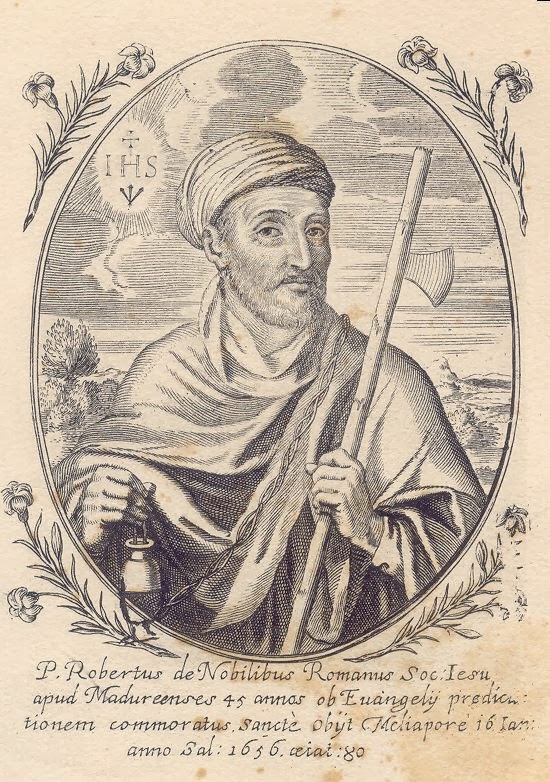
Roberto de Nobili (1577- 1656)
,_gravure.jpg)
I wish to share information about Rev Fr. Roberto de Nobili who spent many years to propagate Christianity among the Tamils.
Roberto de Nobili was an Italian Jesuit born in Montepulciano, Tuscany, in September,1577. He was the first son of a nobleman, a general in the papal army. After his father's demise at the age of seventeen Roberto chose to join the Society of Jesus founded by Ignatious Loyola, in spite of opposition from his family,which had contributed numerous clerics to the Church , including several Cardinals and at two Popes.Thus in 1596, ignoring his family's wishes, he entered the Jesuit novitiate with the intention of becoming a foreign missionary. After a brilliant course of studies he sailed for the Indian mission in October, 1604, arriving at Goa on 20 May, 1605.
After a short stay at Cochin and among the fishermen in coramandal Coast, he moved in November, 1606, to Madurai, great cultural center of Tamils ruled by Telugu Nayaks, patrons of Vedic learning and Hinduism. Here he spent close to next fifty years in the service of his Lord.The policy of Portuguese clergy until then was to try and achieve to increase the number of converts, by conversion of the downtrodden lower classes to Christianity, sometimes forcefully, hardly making contacts with the upper castes. They set strict rules after conversions, getting the new recruits to eat meat, change their entire ways of life etc which earned them no good will, the converts were still considered lower class. The revised priority in India, therefore for the Jesuits, was to free Hindus from the stranglehold of the Brahmins as set by St Xavier. The resident Jesuit priest in Madurai was making not much headway with conversions and not a single Brahmin could be converted thus far. Instead the Portuguese and their Priests earned the sobriquet of Pirangis or Firangis, unclean white-men, bracketed with lower class people.
Soon, Fr.Roberto de Nobili understood the iron bound Caste system that held the Hindu society strongly. As a result, he decided to move ahead and accept the restrictions of caste and refuse to condemn any social custom or idea in this regard. First, he tried to ally the fear that he was a Portuguese (Pirangi) Priest, but a holy man from Italy like a Brahmin in India.. He moved from the missionary compound into a house in the Brahmin quarter of the city and shaved his head and sported a tuft of hair. He spoke only Tamil, hired a Brahmin cook and houseboy, and became a vegetarian. Like many Brahmins, Roberto de Nobili limited himself to one meal a day. He abandoned the black cassock and leather wear of the Jesuits for a saffron robe and wooden clogs. He put sandalwood paste on his forehead to like a Brahmin priest and even wore sacred thread across his shoulder for some time, as a sign of his caste rank.. He referred to himself as an ascetic or a sannyasi. Eventually, he preferred the company of Brahmins and even ate only with them. He bathed daily and cleansed himself ceremonially before saying mass. Thus it looked, instead of converting Brahmins, he converted himself as a Brahmin !
With the help of his scholarly Brahmin associate in the School run by Catholics, he learnt Sanskrit, Tamil and Telugu. In two years he mastered these languages to the extend of conversing fluently in Tamil and Telugu, and studying Sacred Texts of Vedas and Upanishads. Perhaps de Nobili was the " first European to study those venerable classics". In 1613 de Nobili wrote a detailed treatise on Hindu customs, and importance of careful adaptation of missionary methods, "Preaching Wisdom to the Wise- Three Treatises by Roberto de Nobili" which his Portuguese Jesuit superiors disagreed. However in 1623 Pope Gregory XV issued a papal document, that largely approved de Nobili's approach. Through the next forty-five years he wrote over twenty volumes of Catholic teachings in Sanskrit and Tamil.
Roberto de Nobili was a polyglot well versed in fourteen languages. "He composed Catechisms, apologetic works and philosophic discourses in Tamil, and contributed greatly to the development of modern Tamil prose writing". "As he expounded the Christian doctrine in Tamil he coined several words to communicate his message. He used the word "Kovil" (கோவில்) for a place of worship, "arul" (அருள்) and "prasadam" "(பிரசாதம்) for grace, "guru" (குரு) for priest or teacher, "Vedam" (வேதம்) for the Bible, "poosai" (பூசை) for Mass, etc".
Regarding number of Brahmin converts by de Nobili, there are different numbers given in books. But it was not significant. The reason as one author said, by getting converted, Brahmins viewed that they gain nothing. They enjoy status in society, looked after well by the rulers and the rich. Then why should they convert themselves to a new religion.
During his final years Roberto de Nobili courted many controversies and banished to Jaffna, where he had lost much of his eye sight. Eventually the Church refused to allow him back to his favorite Madurai, instead sent to San Thome, Mylapore, Madras, where after spending eight years as a broken, penniless and blind man Rev.Fr.Roberto de Nobili, the Count of Civitella died in the year 1656. His tomb is not identified till now.
Brahmanyan,
Monday, 23 September 2013
Where could we find those kind of people today?
While browsing the internet I stepped into a news item, that took my memory to an incident which happened long back, some time in 1958 or 59. I was returning from Madras to Coimbatore by Nilgiri Express. When the train started from Central two gentlemen rushed to the compartment and got in. It was a third class reserved compartment for sitting. In those days there was no sleeper Compartments. One person was fair and lean, wearing Khadi kurtha, dhothi and a towel over his shoulder and the other was little dark complexioned wearing white shirt, dhothi and a towel over his shoulder. They were allotted seats nearby in the same bench. They were carrying ordinary bags containing their clothes and some documents. They were discussing some politics and the assembly proceedings for some time. The ticket examiner came and when he saw them he respectfully enquired about their welfare and asked whether they would like to upgrade their tickets to travel by first class. The two gentlemen told that it is OK for them to travel by third class.
The fair gentleman turned to me and introduced himself as K.R.Nallasivam, MLA from Chennimalai and the other was N.K.Palaniswami also a MLA ( Communist) from next constituency. He told they would get down at Erode, till then we can adjust and sleep in the available space on the bench.In the meanwhile Sri.Palaniswami climbed up on the luggage rack and spread his towel to sleep. I could not believe at the simplicity and ease with which they moved with others. Later I came to know that Sri K.R.Nallasivam from Kodumudi was an agriculturist and respected Congressman turned staunch Socialist and spent his entire life in the service of people.
He was an MLA for nineteen years from 1952 to 1971 , but did not own any property.
Now please read the news item in the following URL:
The Hindu : Tamil Nadu / Erode News : Cheque given to former MLA’s wife
Brahmanyan,
Bangalore.
Sunday, 10 March 2013
RAVANA BRAHMA - A multi faceted personality.
![]() |
| Siva Thandava |
Ravana was a multi faced personality. The formidable king of Lanka almost came close to becoming an unquestioned ruler of the three worlds. The great epic Ramayana is as much about the defeat of Ravana as much as it is also about the life of Sri Rama, King of Ayodhya. So, had Ravana learnt the lesson of controlling his ambitions, it would not have been necessary for Lord Vishnu to incarnate upon earth as Sri Rama.
Ravana was a direct descendant of Lord Brahma and Brahmin by birth. He was blessed with the very best of parents. His father was the great Sage Vishravas who was the son of Maharishi Pulastya Prajapathi (one of the mind born Saptarishis) and the grandson of none other than Lord Brahma himself. Maharishi Agasthya Muni was the brother of Sage Vishravas. Sage Vishravas had married Devavarni the daughter of rishi Bharadwaja and Princess Kaikasi the daughter of Sumali. While Kubera was the son of Devavarni, Ravana was the son of Princess Kaikesi. His mother Princess Kaikesi was the daughter of King Sumali of the Daithyas or Asuras. The Daithyas were descends of Diti, the second wife of Sage Kashyapa, thus were brothers to the Devas who were descended from Aditi, Kashyapa’s first wife.
Princess Kaikesi was a very ambitious lady and that the Sage Vishravas recognized her true ambitions when she asked him to marry her. Sage Vishravas also warned Princess Kaikesi that , their offspring may turn out to be bad. But, this information did not deter Princess Kaikesi who was soon blessed several children.The eldest of Princess Kaikesi’s children was Ravana. At birth Ravana was given the name of Dashanana or Dasagriva, since he was said to have the mental strength of ten people. He was an exemplary scholer and mastered all the Vedas and Sastras under his father. He was a great Veena player. He was a Samavedin. He was an ardent devotee of Lord Siva and known for his Siva Tandava. Due to this only he was named Ravana by none else than by the Lord Siva himself. He had two younger brothers namely Vibhishana and Kumbakarna. In addition, Kaikesi gave birth to a daughter by the name Soorpanakha.
However different sources cite Ravana having more siblings than the ones named. For instance, Ravana is said to have had a brother named Mahiravana who was a powerful magician and became the ruler of the netherworld. In addition, there is also mention of Khara and Dushana in the Ramayana. But, all sources agree that Ravana also had a half brother older than him, Kubera, the lord of wealth, the first son of Vishravas. Ravana always had a contentious relationship with his half brother.
As a child Ravana was very diligent and intelligent, an ideal scholar in all respects. However, his father also noted that Ravana tended to be arrogant and aggressive, taking after his maternal side. Ravana was very well educated and he was recognized as a learned and proficient individual even by his enemies. He mastered the Vedas, Shastras and the ways of the Kshatriyas. His mastery in the use of every weapon was well known and he was a great sorcerer. His father Sage Vishravas must have realized that Ravana was meant to rule a kingdom. However, he also noted that Ravana tended to be arrogant and aggressive, taking after his maternal side.
Ravana performed several yagnas as a Brahmin including the one for no other than Lord Shiva and Parvati themselves. The puranas tell us about the magnitude of Ravana’s learning and skill. He was unmatched in his knowledge of the nitishastra. Indeed, after his defeat towards the end of the Ramayana, Rama orders his brother Lakshmana to learn the art of nitishastra from the dying Ravana. In addition, he was a renowned Veena player, his personal emblem being the Veena. Already a great musician and scholar, Ravana added leadership qualities to his list of virtues. He was the undisputed leader amongst his siblings and even after growing up, his brothers and sister except Vibheshana would primarily defer to his judgment despite having differences of opinion.
Ravana had several wives but foremost among them was Queen Mandodari daughter of Maya.She was known for her beauty, grace and chastity. She was one of the pancha kanyas according to Hindu mythology and merely reminding her name is said to wash away all the sins. Princess Mandodari was the daughter of Maya the divine architect and Hema a celestial dancer. Maya was a descendant of Diti and hence was an asura . Thus Maya was known as Mayasura and also as Maya Ditya.
After nearly completing his domination of the worlds, Ravana returned to Lanka to rule over his dominions. As a citadel designed by none other than Vishwakarma,the architect of the Gods, Lanka was matchless. Its walls were strong and well defended. A guardian spirit watched over the main gate ensuring that enemies never entered the city. The legends talk about the wealth of Lanka during the rule of Ravana. It was said that hungar was virtually not known and even the poor ate out of vessels of gold and silver. Ravana himself was credited to have been a very able and benevolent administrator. He was ably aided in this by his brother Vibheshana who continued to follow the path of Dharma above all things. Vibheshana was with Ravana and helped to moderate all his orders until he got banished from the kingdom for speaking against the abduction of Sita, wife of Rama.
Ravana’s life was a classic example of brilliance gone wrong. He had gained the very best instruction and was truly great in his abilities and achievements, a fact that was appreciated by his favorite God Shiva. However,unfortunately he never learnt the virtue of humility. His arrogance and conceit proved to be his nemesis. Instead of following the path of Dharma, he chose to flout it time and again. Instead of gaining fame for his countless good qualities, Ravana became known for his improper behavior towards humans and women in particular. His atrocities kept growing in number and eventually became so terrible, that it took an incarnation of Lord Vishnu to subdue him.
Absolute power corrupts absolutely and the mighty Ravana moved from one blunder to another, angering many a mortal and God in the bargain. A true devotee of Lord Shiva , Ravana is said to have composed the "Shiva Tandava Stotra" while trying to gain boons from Shiva. Shiva who was busy at the moment dancing the tandava with his consort Parvati knew of his devotee’s intentions but chose to ignore them. Ravana decided to lift the Kailasa Mountain, the abode of Lord Shiva and take it with him to Lanka. Lord Shiva, in turn enraged by Ravana’s presumptions trod heavily back with his toe, nearly crushing Ravana in the process. It is at this time that Ravana realized his mistake and begged the Lord to end the misery, even sacrificing his numerous heads to the God. A calm Shiva appeared before Ravana and presented him with the Atma Lingam after formally naming him Ravanasura. Ravana continued on his way back to Lanka taking the Atma Lingam with him only to lose it on the way. The spot is now said to be Rameshwaram today.In the end, as he lay dying on the battlefield, holding on to the very last breath and giving Lakshmana instruction on Nitishastra and proper administration, Ravana is said to have commented dryly, “Never assume that you have all the time in the world and take nothing for granted. Never procrastinate. I conquered the
Heavens and imprisoned Yama, the lord of Death to my bedstead and Shani, the ninth planet under my throne. I told myself that I will always have time to finish them later. What good did this procrastination do? They prevailed anyway.”
.I
There is an interesting anectode about one class of Brahmins known as "Saryuparin Brahmins" in North India. When Lord Rama returned to Ayodhya after his victory in Lanka, he wanted to perform "Aswamedha Yagna". For this purpose he invited the local Brahmins to perform the yagna. But they refused the offer since Rama did the sin of Brahma-hatya by killing Ravana, the son of a Brahmin. However some Brahmin families acceped the request of Lord Rama and performed the Yagna. For which they got Lands and wealth at the other side of River Sarayu. Thus the descendants of these families are called "Sarayupari Brahmins" even today. These Brahmins are also called "Kanyakubja Brahmins". Their families spread over many places in UP and Madhya Pradesh.One of the famous persons belonging to the "Kanyakubja Brahmins" sect is Sri Atal Behari Vajapayeeji.
Sunday, 29 November 2009
Sripuram Golden Temple - Manifestation of Divine Opulence

Our visit to the Lakshmi Narayani Temple also known as Mahalakshmi Temple, at Sripuram, Vellore yesterday, (November, 28, 2009) was a memorable one for me. When I saw the magnificent Creation of the Golden Temple, the following lines from Chapter 10 of Bhagavat Gita came to my mind.
yad yad vibhutimat sattvam srimad urjitam eva va
tat tad evavagaccha tvammama tejo-’msa-sambhavam (BG.Ch.10(41)
"Know that all opulent, beautiful and glorious creations spring from but a spark of My splendor“
Sri Madhwacharya in his commentary to this Sloka says
“In whatever forms the manifestations of majesty, greatness, beauty and power are seen, they should be known as minuscule fractions of Lord Krishna's vibhuti or divine, transcendental opulence“.
Indeed that is what we have at Sripuram Sri Lakshminarayani Golden Temple.
Sri Narayani Peedam is located in Malaikkodi (Tirumalaikkodi)மலைக்கோடி (திருமலைகோடி) a small village just 8 Kms from Vellore. Sri Arul Sakthi Amma.( Lovingly called as Amma). the chief of Sri Narayani Peedam is the motivating power for the entire scheme of activities in the Narayani Peedam. Sri Sakthi Amma is just 33 years old. But the amount of work he has done with in the short span of 16 years after instituting the Narayani Peedam supports the view that Sri Sakthi Amma is a chosan Avatar to perform this great job ordained by the divinity. The Mahalakshmi Golden Temple at Srpuram is an extraordinary work of art. Magnificent in every respect. This wonderful work of art is situated in the midst of 100 acres of lush green landscape. The Temple complex covering 55,000 sq.ft. area is surrounded by six cornered star shaped 3.5 kms of pathway. The first glimpse of this awe inspiring sight of the Golden Temple stops our mind to silence. Soon the query arises “How could this be possible? “.It is an architectural marvel, which has consumed 1.5 Tonnes of pure Gold and seven years of intelligent labour by traditional artists. This temple is designed under Agamic rules of Dravidian Temple architecture with an Ardha Mandapam, Maha Mandapam and Garbagruham. The main Gopuram or Tower is on the Garbagruham. It looks that the roofing on the Ardha mandapam and Maha Mandapam has been done on traditional Chola Architecture. The main Gopuram reminds us that of the Gopuram on the Garbagruham of Sri Venkateswara Temple at Tirumalai.. The Temple itself has 36 ornately decorated Pillars, all covered with Gold and there are 15 crystal chandeliers hung in the Maha Mandapam. Every part of the Temple is decorated with mythical figurines, flowers and animals. All covered in Gold. These are fantastic work of Art, planned and executed meticulously.
.After visiting the magnificent Golden Temple while we were on the way to the old Swayambu Temple, we met the young man whom our host, who took us round the Holy abode of Sri Lakshmi Narayani Temple and Narayani Peedam, introduced him as the Chief of the team of 400 specialised Gold and Coppersmiths from TTD who had completed the Golden Temple of Sri Puram, near Vellore. What a surprise! I never thought I would meet the person who had blessings of God to create such a magnificent Structure designed and guided by Sri Arul Sakthi Amma
Sri Narayani Peedam under the guidance of Amma has initiated several charitable projects for the welfare of people in the surrounding villages. That includes Specialty Hospital and health care, educational insatitutions, Drinking water programme, Aforestisation scheme , Child care, shelter for destitutes etc.
I am not going into the cost of these projects . It is my view that money well spent for the welfare of humanity deserves to be encouraged. All arrangements for the Pilgrim are excellent. The Security is tight and stringent, but very polite. No where we experience any difficulty..Proper guidance, assistance and information available inside the complex. More information on Sripuram is available in the following website:
Thursday, 15 October 2009
Happy Deepavali
Best Wishes for a Happy Deepavali.
In Southern part of India Deepavali celebrated as Narakachathurdasi to commemorate “Victory over evil” for killing of demon King Narakasura ruler of kingdom of Pragjothisha in Assam by Sri Krishna with the help of his consort Sathyabhama. It is a big festival in Tamil Nadu. The event is celebrated with early morning oil bath, wearing new dresses, lighting of lamps and pooja. Burning fire crakers and distribution of sweets amongst friends and relatives have become a must.
Regards,
Brahmanyan
Wednesday, 1 July 2009
Srimad Ramayanam.
Srimad Ramayanam.
A lively controversy is going on in our Country about Rama-Sethu, Rama and Ramayanam now. It all started with the plan of building a water way for shipping cutting across the legendary Rama-sethu in Palk Straits. Our, self proclaimed "noted Historians" and experts jumped in the debate as usual after reading news reports. Some of them had gone to the extent of doubting the legitimacy of Valmiki Ramayanam as well. Our visual media who are waiting like hawks for a controversy opened up debates and panel discussions with known political faces, on the subject. In the mean while our Dr.Subrahmanyan Swami (who else!) tookup the matter to the Supreme Court (SC) to stop the construction and got a stay order too. In response to the Court order the Union Government asked the Archeological Survey of India (ASI) to file an affidavit in the SC. The Minister incharge of Cultural Affairs, as usual, had gone on tour, this time to to Japan to attend some meeting and left the matter in the able hands of ASI.
Well, here comes the interesting part of the story. As per "The Indian Express" the Central Government told the SC that "contents of Valmiki Ramayana, the Ramacharitamanas by Tulsidas and other mythological texts, which admittedly form an important part of ancient Indian literature...cannot be said to be historical record to incontrovertibly prove the existence of the characters, or the occurrence of the events, depicted therein".
ASI in their counter affidavit on behalf of the Government said further that "Adam's Bridge is merely a sand and coral formation which cannot be said to be of historical , archaeological or artistic interest of importance". Reminding the court that it had in a separate case defined archaeology as "a study of human history and prehistory through excavation of sites and analysis of physical remains", the ASI said the" Adam's Bridge site cannot, therefore, be said to be of any archaeological interest".
"Unless these ingredients are satisfied, the question of construing Adam's Bridge as an ancient monument and declaring it as a protected monument does not arise".
Understandably ASI has defined the correct position. But the question is .who is to do this job? It is the job of ASI only. If so,why it has not been done before arriving at the conclusion. For this also ASI has an answer. The ASI said that the formation known as 'Adam's Bridge' has till date not been declared as a "protected area" or a "protected monument" or as an "ancient monument". under the provisions of the Act as there has been no occasion for it to even make a primafacie determination that the said formation could be an ancient monument entitled to protection and therefore the ASI has not undertaken any study in this regard as yet. But concluded "After considering the available materiel the ASI has reasonably concluded that the formation known as Ramar sethu/Adam's Bridge is not a man made structure, but rather a natural structure made up of shoals/sand bars".
Laymen like me wonder how could a professional body like ASI could file a determined Affidavit with the highest Judicial forum like Supreme Court of India on such a sensitive issue without undertaking proper investigative study. Interestingly, foreign agencies who had done better study with satellite imagery have not come to a conclusion for certain.
Sethusamudram Project was planned since many years. Originally proposed by Com. A.D.Taylor of British Marine in 1860, it did not take off for one reason or other in spite of examination by many committees appointed by then Governments. But from the records, it seems there has been extensive sampling and research done on various levels to satisfy the economic viability of the Project. The idea is to shorten the navigable distance by 784 KMS and 30 hours of journey for ships proceeding from Eastern Ports in Bay of Bengal to ports in Arabian Sea. Also the project is expected to give a boost to the economic and industrial development of coastal Tamil Nadu. That's a good point indeed.
Ultimately after considering various reports the Sethusamudram Ship Channel Project (SSCP) was finalised in 2000-01. "The SSCP envisages dredging of Two ship channels across the Palk Straits between India and Sri Lanka. One across north of Adam's bridge (Rama Sethu) chain of islets and shallows linking India with Sri Lanka South east of Pamban Island and the other through the shallows of Palk Bay by deepening the Palk Straits. The total length of these two channels would be 89 Kms".
Next let us consider what are the objections for taking up the Project. First the ecological and environment objections. The Gulf of Mannar and Palk bay covering about 10,500 Sq.Kms are biologically rich and rated among the most highly productive seas in the world. This region provides livelyhood for several lakhs of fishermen in coastal villages of Tamil Nadu from Ramanathapuram to Tutucorin Districts. The fear is that after completion of this project the noise pollution due to shipping activity would cause enormous ecological disaster and irreparable loss to the system with devastating effect on aquatic life which was built by nature over millions of years. This will affect the fishing community in a big way. The Government had considered this aspect carefully and the experts appointed by them had given detailed reports on every aspect affecting socio-economic environment profiles and ecological analysis.
Second. Religious.To start with, how many of us knew the existance of Rama-sethu formation or visited the site, before this controversy ? Very few, perhaps only the fishermen around the place and the Government officials would have known about it. But Sage Valmiki who compiled Srimad Ramayana perhaps from some where in north had described Sethu bandanam in detail, as to how it was built under the supervision of Nala, more distinguished among the monkeys and son of Viswakarma.the celestial architect(Slokas 2-22-50 and 2-22-72). According to Valmiki Ramayanam the bridge across Sethu built by Nala in five days was of Ten Yojanas width and One Hundred Yojanas in length. Srimad Ramayanam is an "Itihasa", historical account passed on from generation to generation by word of mouth. We must understand that Sage Valmiki had written the epic Ramayanam from the details as available to him. But when we read the epic we will understand his knowledge of Geographical locations is astounding. He did not have the facility of modern day Atlas or Sattalite imagery. But we can see all the locations mentioned in the Epic accurately even today. Hence I have to believe that the incidents mentioned in the great epic should have happened at some time or other in our country. Being a poet, Valmiki might have taken the liberty of deviating from the main story by"exaggeration and embellishment", just like any other poet.
Faith and belief are beyond scientific scrutiny. This is very true in the matter relating to one's Religion. Most of the people who believe Ramayana and Sri Rama feel that what we see today in Rama-sethu is the remnants of the bridge built be Sri Rama and his associates, and it should not be disturbed for any reason. Some others are of the view that it is a natural formation. There are enough research material available supporting both sides of the arguement. But the fact is it is there, whether it is a man-made or natural formation.As for me it is a heritage site, and it should be protected.
If we go through the history of the Sethusamudhram Project we find Nine Committees had done detailed study and presented proposals during the Pre-Independence era between 1860 and 1922, but no progress was made obviously due to lack of finance. Again the project was taken up and five fresh proposals were made during post independence period between 1956 and 1997. Almost all the committees had suggested cutting the canal north of Rameswaram Island. Finally a Committee under the chairmanship of Mr.H.R Lakshminarayan was constituted in 1981 to proceed further. The Committee collected the opinions and representations of the leading Public, Industrialists and Government Officials of the State. All of them accepted the importance of the Project and urged the Government to execute the scheme at the earliest. But the prominent citizens of Rameswaram Island represented that the canal would serve better if located east of Rameswaram Town as far as possible, as it would otherwise affect the movement of th pilgrims of the Temple town. Accepting the same the committee proposed a new alignment across Dhanushkodi one Km. from Kothandaramaswamy Temple.
So far so good.
Till then there was no objection from any quarters on Religious reasons. But the trouble started only when the politicians jumped into the project. It went to the extent of some worthies questioning the existence of Sri Rama! And some other has asked in which engineering college Sri Rama had studied. All unwanted comments. Which only added fuel to the fire. Now the Nation is spending its time and energy on an unwanted controversy.
To avoid further division I feel it is time that the Government should take a fresh look at the entire project basing on the Report and the proposals given by the committee headed by Sir A,Ramaswamy Mudaliar in 1956, which had suggested the canal crossing the main land at Mandapam. This new alignment I hope will not disturb the Rama-sethu Heritage site.
posted on Monday, September 17, 2007 10