Saturday, 10 October 2015

DARA SHIKOH - THE ENLIGHTENED PRINCE


DARA SHIKOH


Prince Shahab ud-din Muhammad Khurram's (Mughal Emperor Shah Jahan) prayers at the Dargah of great Sufi mystic Hazarat Kwaja Moinuddin Hassan Chisti at Ajmer, for a male heir, was answered on Safar 19, 1024 AH (March 20, 1615 AD) by the birth of a male child to his beloved wife Arjumand Banu Begam (queen Mumtaz Mahal) at Sagartal near Ajmer. Grand father Emperor Jahangir named the child Dara Shikoh,in Persian meaning "Darius the magnificent". His full name was "Sultan Mohammed Dara Shikoh"


Dara Shikoh was a unique personality among the Mughal dynasty from 1526 AD to 1827 AD. Like other Mughal princes,  he had his earlier education from Maulvis attached to the Royal Court, who taught  Al Qur'an, Persian literature and History. The chief instructor Mullah Abdul Latiff Shahranpuri a liberal Sufi muslim,  encouraged the young Prince  a thrist for gaining knowledge in metaphysics and speculative sciences.The mystical and intellectual environement of that Mughal times nurtured Prince Dara the deep interest in pursuit of gaining knowledge in arts and litereture. During this period, young Dara interacted with host of Islamic and Hindu mystics, Pundits and yogis, including Shah Muhibhulla, Shah Dilruba, Muhammad Nisanulla Rostaki, Baba Lal Das Bairagi and Pandit Jagannath Mishra ,  some of them excercised profound influence on him. The most noted among them was Hazrat Miyan Mir, the Quadri Sufi of Lahore, who had laid foundation stone of Golden Temple of Sikhs at Amritsar. Impressed by the teachings of Hazrat Mir, Dara got initiated to Quadri Sufi order.After the initiation into quadri order, Prince Dara spent more time with his preceptor Hazarat Mian Mir, Mulla Badakhashi and other Sufi saints which encouraged him in the deep study of mysticism. During this period Prince Dara published his major writings on Sufism. These are the Safinat-ul-Aulia (1640 AD), the Sakinat-ul-Aulia (1653 AD), both biographical sketch of Sufi Saints and three more books, exposition on Sufi fundamental doctrines, the Risala'i Haq Numa (1647 AD) the Tariqat-ul-Haqiqat and the Hasanat-ul-Arifin (1653 AD).


Dara Shikoh  was deeply interested in comparative religions, universal brotherhood and humanism, which he had imbibed from his great grandfather Emperor Akbar and deep interest in studies from Humayun. These influences played a notable role in developing his personality. Dara Shikoh had no liking for luxurious life  or sensual pleasures, instead developed refined tastes in life. His interests turned towards finding common grounds between Islam and Hindu thoughts. For this purpose Dara spent many years in the study of Sanskrit and employed a large number of Pandits from Benaras including contemporary scholars Pandit Jagannath Misra, Pandit Kavindracharya and Banvali Das. Pandit Misra has written a book "Jagatsimha" in praise of Dara. After his interaction with Baba Lal Das Bairagi, Dara brought out a summery of his teachings in a booklet "Makalama Baba Lal wa Dara Shukoh" highlighting similarities in the teachings of Hindu and Muslim Mystics. He found  common elements in Quadiri Ashghal and Yogic meditational techniques, which inspired him to bring out Persian tranlation of Yogavasishta in 1650 AD. followed by a Persian translation of Bhagavad-Gita.


In all,Dara Shikoh arranged for translation of fifty-two Upanishads into Persian, and had named it "Sirr-e-Akbar" (the Great Secret). In its forward Dara Shikoh writes " I had collected a large number of Hindu Pandits and Sanyasis from Benaras, the center of the Hindu lore and wisdom, with whose help I completed this work within six months in Delhi" (by June 28, 1657 AD).

Dara Shikoh's efforts to find commonality in comparative religions resulted in bringing out  an extremely remarkable book "Majma-ul Bahrain" - "The Mingling of two Oceans" (1656 AD) considered his magnum opus.He describes this book as "the collection of truth and wisdom of two truth knowing groups".

In the notes given in the book "Travels in the Mogul Empire 1656-1668 AD" by french traveller Francois Bernier, it is stated:

"Dara Shikoh, when Governor or Viceroy of Benares, in 1656,caused a Persian translation to be made from the Sanskrit text of the Upanishads ('the word that is not to be revealed'), which he called the Sarr-i-Asrar, or Secret of Secrets. This translation, which was made by a large staff of Benares Pandits, has been rendered into Latin by Anquetil-Duperron, and published by him at Paris, 1801, under the title of Oupnekhat {id est, Secreticm I'egendum) opus ipsain India rarissimum, etc. etc.."

This latin version got in the hands of German Philosopher Arthur Schopenhauer, and was later translated into German by Friederich Max Muller for Philosopher Friedrich Schelling. Later this was translated into many European languages.


Dara Sukoh was a patron of fine arts, poetry and dance. He was well read in classical Persian literature. He himself had written poems in Persian. He had expressed his sufistic views in beautiful quatrains and Gazals. He was an accomplished artist and calligraphist. He had left a collection of his paintings and calligraphy collected from 1630 till his death in an album known as "Dara Shukoh Album", which is believed to be in British Library now.

On February 1, 1633 AD, Dara Shikoh married Karim-un-Nisa Nadira Banu Begum, his first cousin, daughter of his paternal uncle Sultan Parvez Mirza. They led  a happy and successful married life. Dara never took another woman as wife. Though the couple had eight children, only two sons and two daughters survived.


Emporer Shah Jahan formally declared his elest son Dara Shukoh as his heir on September 10, 1642 AD. and granted him the title "Shahzada-e- Buland Iqbal" Prince of High Fortune.

How ever, the spate of misfortunes overtook the life of the Prince when Emporer Shah Jahan fell ill in September 1657AD. A desperate power struggle triggered among the four Princes. Aurangzeb and Murad joined togather and defeated Prince Dara in the battle of Samugarh. Aurangzeb grabbed the throne in 1658 AD, and imprisoned his father in Agra Fort, where Shah Jahan died after eight years. Dara had to run away to Sindh to seek the help of Malik Jiwan, Afghan Chieftain. Later Dara was caught by Aurangzeb due to the treachery of the same Malik Jiwan, and brought to Delhi and humiliated. At the instance of Aurangzeb, Prince Dara was accused of infidelity and heresy by a religious court and put in prison and executed on August 30, 1659 AD. under Royal decree issed by Aurangzeb. It is said after his death his head was cut and sent on a platter to his father Shah Jahan lamenting in Agra fort.

Had this gentle and pious intellectual Prince ruled our Country, history would have taken a different course of religious tolerance and amity. Prince Dara Shikoh was a devout Muslim, it is said he used to chant Allah's name before translating Upanishads.

His body lies buried in a nondescript grave in the burial complex at Emperor Humayun's tomb in Delhi.

   
Brahmanyan,
Bangalore.


Friday, 29 May 2015

TEARS OF LORD SHIVA

Tears of Lord Shiva:


There is a holy pond in Pakistan along with hindu temple complex in Katas raj. This ancient Hindu Temple complex is situated  40 Kms from  Chakwal city in the District of same name in Punjab, Pakistan. The locals call the complex as “Qila Katas  Hindhu mandir".The main temple is a dedicated  to Lord Shiva. It is said that the temple has been in existance prior to the days of Mahabharata and the Pandavas have spent substantial part of their period of exile at this holy place. It is also believed that this is the pond where the famous dialogue between the Yaksha and King Yuthishitra known as "Yakshaprasnam" had taken place.


As per  the mythological account origin of this temple and tank is related to Sathi devi's death. It is believed that after the death of his beloved consort,  lord Shiva shed tears so much and so long that the tears from one eye of the Lord  is said to have created the holy pond at Katas, ( Keta-aksha in Sanskrit  means 'weeping eye',). And tears from the other eye has created the holy tank at Pushkar, near Ajmer, Rajastan. 

According to historians, during Gandhara age, scholars from many parts of the world have visited Katas raj to study in the famous University established here.This  is the place where the famous Persian Scholar Al Bairuni,  who had written "  Kitab- Al-Hind",after exploring the religious faith practiced in India had spent some period of stay at Katas raj to learn Sanskrit in the linguistic University, established there. Chinese traveller Hiuen Tsang said to have visited this place around 630 AD and mentions about Katas in his writings. According to one account most of these temples were built by  Hind-shahi kings (650-950 AD) driven from Afghanistan by their ethinic cousin Mahmud of Ghazni they fled the region and set a base in Katas.  

Prior to partition in 1947 , this Temple complex has attracted tens and thousands of Hindu pilgrims from the sub-continent, and other parts of the world, through out the year. However after the partition the flow subsided and virtually came to an end after 1965 war.  In 2005, at the invitation of General Musharraf then President of Pakistan, Shri L.K.Advani visited Katas Raj to launth the renovation  program of Katas Raj Temple complex initiated by the Government of Pakistan. And the Indian government was quick to dispatch an Archaeological Survey of India team to survey Katas Raj and facilitate a whistle stop tour of Indian temples for Pakistani archaeologists. Accordingly the Pakistani delegation led by the Punjab Archaelogy Director General Oriya Jan Maqbool was on a 10 day trip to study Hindu architecture and customs, and visited several important Temples in  India. The first three year phase of renovation was the complex at the cost of Rs 60.3 million was completed in 2007. A "Siva Linga" was installed and consecrated on February 16, 2007.  


Saturday, 25 January 2014

First Tamil Printed Book.


                    When I was searching for information on Religious conversions in India, I stepped into some interesting information, one among them was, that the printing in First non European language was Tamil. Here is a brief account of the same:


                     தமிழின் முதல் அச்சு புத்தகம்
"ஆகாசமும் பூமியும் படச்சவன் சர்வமும் ஆனவனே, பிதாவே தம்பிரானே விசுவாசம். அவ்வண்ணம் என்னடே கர்த்தாவே யேசு கிறிஸ்து அவ்வனடே புத்ரனே ஒருவனே. சுத்தமான சித்தத்தினொடெய கருணே கொண்டு கெற்பம் ஆயி: கன்னியாஸ்திரி மரியத்தில் பெறந்தவன்: போஞ்சியு பிலாத்து விதித்த விதிகொண்டு வெசனப்பட்டு: குருசினில் தூக்கிச் செத்தான்: குழில் வைத்து.."

Above is a passage is from the first Tamil Printed book " Thambiran Vanakkam" (தம்பிரான் வணக்கம்) printed in India in 1578. It is a matter of record Tamil was the first non-European Language to be printed in movable type. The credit should go to the untiring efforts of a Portuguese Jesuit Priest Fr.Anrique Anriquez (1520–1600) better known as Fr.Henrique Henriques, who spent most of his life in missionary activities among Paravars in South India. He strongly believed that books of religious doctrines should be in local languages and to this end he wrote books in Tamil. The first such book printed in Tamil Script was Thambiran Vanakkam (தம்பிரான் வணக்கம்) (1578), a 16-page translation of the Portuguese “Doctrina Christam”. It was followed byKirisithiyaani Vanakkam (கிரிசித்தியானி வணக்கம்)(1579). These were works of catechism, containing the basic prayers of Catholicism. Before this ‘Cartilha’, a Tamil prayer book printed using Latin script, was printed in Lisbon by command of the King of Portugal and financed by the Paravar Christians community of Tuticorin, who also helped with scholarly assistance. The first known Tamil typeset for printing was cast in 1577 at Goa by a Spanish Jesuit Fr Juan Gonsalvez "who succeeded in makingMalauar (Tamil) printing press". The first Tamil Book "Tambiranvanakkam" was printed in this Printing Press at Kollam, Malabar.
Fr Henrique Henriques is sometimes called The Father of the Tamil Press. After his death his mortal remains were buried in Our Lady of Snows Basilica in Tuticorin, India.

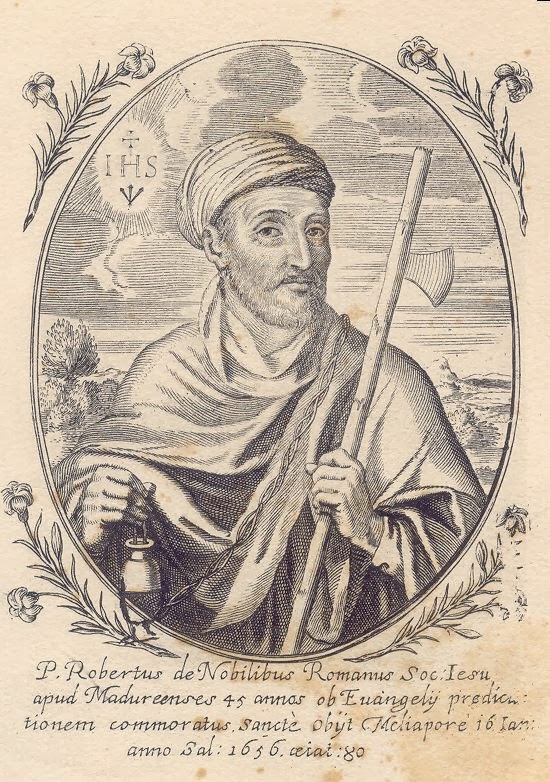
Roberto de Nobili (1577- 1656)

                             Roberto de Nobili (1577- 1656)

I wish to share information about Rev Fr. Roberto de Nobili who spent many years to propagate Christianity among the Tamils.

Roberto de Nobili was an Italian Jesuit born in Montepulciano, Tuscany, in September,1577. He was the first son of a nobleman, a general in the papal army. After his father's demise at the age of seventeen Roberto chose to join the Society of Jesus founded by Ignatious Loyola, in spite of opposition from his family,which had contributed numerous clerics to the Church , including several Cardinals and at two Popes.Thus in 1596, ignoring his family's wishes, he entered the Jesuit novitiate with the intention of becoming a foreign missionary. After a brilliant course of studies he sailed for the Indian mission in October, 1604, arriving at Goa on 20 May, 1605.

After a short stay at Cochin and among the fishermen in coramandal Coast, he moved in November, 1606, to Madurai, great cultural center of Tamils ruled by Telugu Nayaks, patrons of Vedic learning and Hinduism. Here he spent close to next fifty years in the service of his Lord.The policy of Portuguese clergy until then was to try and achieve to increase the number of converts, by conversion of the downtrodden lower classes to Christianity, sometimes forcefully, hardly making contacts with the upper castes. They set strict rules after conversions, getting the new recruits to eat meat, change their entire ways of life etc which earned them no good will, the converts were still considered lower class. The revised priority in India, therefore for the Jesuits, was to free Hindus from the stranglehold of the Brahmins as set by St Xavier. The resident Jesuit priest in Madurai was making not much headway with conversions and not a single Brahmin could be converted thus far. Instead the Portuguese and their Priests earned the sobriquet of Pirangis or Firangis, unclean white-men, bracketed with lower class people.

Soon, Fr.Roberto de Nobili understood the iron bound Caste system that held the Hindu society strongly. As a result, he decided to move ahead and accept the restrictions of caste and refuse to condemn any social custom or idea in this regard. First, he tried to ally the fear that he was a Portuguese (Pirangi) Priest, but a holy man from Italy like a Brahmin in India.. He moved from the missionary compound into a house in the Brahmin quarter of the city and shaved his head and sported a tuft of hair. He spoke only Tamil, hired a Brahmin cook and houseboy, and became a vegetarian. Like many Brahmins, Roberto de Nobili limited himself to one meal a day. He abandoned the black cassock and leather wear of the Jesuits for a saffron robe and wooden clogs. He put sandalwood paste on his forehead to like a Brahmin priest and even wore sacred thread across his shoulder for some time, as a sign of his caste rank.. He referred to himself as an ascetic or a sannyasi. Eventually, he preferred the company of Brahmins and even ate only with them. He bathed daily and cleansed himself ceremonially before saying mass. Thus it looked, instead of converting Brahmins, he converted himself as a Brahmin !

With the help of his scholarly Brahmin associate in the School run by Catholics, he learnt Sanskrit, Tamil and Telugu. In two years he mastered these languages to the extend of conversing fluently in Tamil and Telugu, and studying Sacred Texts of Vedas and Upanishads. Perhaps de Nobili was the " first European to study those venerable classics". In 1613 de Nobili wrote a detailed treatise on Hindu customs, and importance of careful adaptation of missionary methods, "Preaching Wisdom to the Wise- Three Treatises by Roberto de Nobili" which his Portuguese Jesuit superiors disagreed. However in 1623 Pope Gregory XV issued a papal document, that largely approved de Nobili's approach. Through the next forty-five years he wrote over twenty volumes of Catholic teachings in Sanskrit and Tamil.

Roberto de Nobili was a polyglot well versed in fourteen languages. "He composed Catechisms, apologetic works and philosophic discourses in Tamil, and contributed greatly to the development of modern Tamil prose writing". "As he expounded the Christian doctrine in Tamil he coined several words to communicate his message. He used the word "Kovil" (கோவில்) for a place of worship, "arul" (அருள்) and "prasadam" "(பிரசாதம்) for grace, "guru" (குரு) for priest or teacher, "Vedam" (வேதம்) for the Bible, "poosai" (பூசை) for Mass, etc".

Regarding number of Brahmin converts by de Nobili, there are different numbers given in books. But it was not significant. The reason as one author said, by getting converted, Brahmins viewed that they gain nothing. They enjoy status in society, looked after well by the rulers and the rich. Then why should they convert themselves to a new religion.

During his final years Roberto de Nobili courted many controversies and banished to Jaffna, where he had lost much of his eye sight. Eventually the Church refused to allow him back to his favorite Madurai, instead sent to San Thome, Mylapore, Madras, where after spending eight years as a broken, penniless and blind man Rev.Fr.Roberto de Nobili, the Count of Civitella died in the year 1656. His tomb is not identified till now.

Brahmanyan,

Monday, 23 September 2013

Where could we find those kind of people today?

Where could we find those kind of people today?

While browsing the internet I stepped into a news item, that took my memory to an incident which happened long back, some time in 1958 or 59. I was returning from Madras to Coimbatore by Nilgiri Express. When the train started from Central two gentlemen rushed to the compartment and got in. It was a third class reserved compartment for sitting. In those days there was no sleeper Compartments. One person was fair and lean, wearing Khadi kurtha, dhothi and a towel over his shoulder and the other was little dark complexioned wearing white shirt, dhothi and a towel over his shoulder. They were allotted seats nearby in the same bench. They were carrying ordinary bags containing their clothes and some documents. They were discussing some politics and the assembly proceedings for some time. The ticket examiner came and when he saw them he respectfully enquired about their welfare and asked whether they would like to upgrade their tickets to travel by first class. The two gentlemen told that it is OK for them to travel by third class.

The fair gentleman turned to me and introduced himself as K.R.Nallasivam, MLA from Chennimalai and the other was N.K.Palaniswami also a MLA ( Communist) from next constituency. He told they would get down at Erode, till then we can adjust and sleep in the available space on the bench.In the meanwhile Sri.Palaniswami climbed up on the luggage rack and spread his towel to sleep. I could not believe at the simplicity and ease with which they moved with others. Later I came to know that Sri K.R.Nallasivam from Kodumudi was an agriculturist and respected Congressman turned staunch Socialist and spent his entire life in the service of people.
He was an MLA for nineteen years from 1952 to 1971 , but did not own any property.
Now please read the news item in the following URL:

The Hindu : Tamil Nadu / Erode News : Cheque given to former MLA’s wife
ERODE:Saturday, Feb 16, 2008:The wife of a former MLA was presented a cheque for Rs. 2 lakh.
K.R. Nallasivam, a veteran Socialist leader and All India President of SP, represented the then Chennimalai Constituency as MLA from 1952 to 1957, again from 1957 to 1962 and also from 1962 to 1967.
Then, after formation of Modakurichi constituency in 1967, he became the first MLA of the constituency of the Socialist Party contesting on the banyan tree symbol. He represented the constituency till 1971. He died in 1975 after a brief ailment.
He left behind his wife, son and daughter. He was not having any immoveable property and on lease he and his son maintained four acres of land, owned by the Thiruvaduthurai Aadheenam.
After his death his son is maintaining the land. Nallasivam’s wife Saraswathy aged 72 now, and her son N. Ravindran are in poor status.
Coming to know of this, the present Congress MLA representing Modakurichi, R.M. Palanisamy, raised the issue in the Tamil Nadu Legislative Assembly and spoke about the family circumstances of K.R. Nallasivam.
Immediately, Chief Minister M. Karunanidhi declared that on behalf of the Tamil Nadu Government, a sum of Rs. 2 lakh would be given to N. Saraswathy, wife of late K.R. Nallasivam.
The cheque for Rs. 2 lakh was handed over to her on Thursday by the Handlooms and Textiles Minister N.K.K.P. Raja in the presence of R.M. Palanisamy MLA and Chairman of the Erode Panchayat Council S.V. Saravanan.
Receiving the cheque, N. Saraswathy thanked the Chief Minister for the timely help rendered to her.

Brahmanyan,
Bangalore.

Sunday, 10 March 2013

RAVANA BRAHMA - A multi faceted personality.

Siva Thandava
RAVANA BRAHMA - A multi faceted personality.

Ravana was a multi faced personality. The formidable king of Lanka almost came close to  becoming an unquestioned ruler of the three worlds. The great epic Ramayana is as much about the defeat of Ravana as much as it is also about the life of Sri Rama, King of Ayodhya. So, had Ravana learnt the lesson of controlling his ambitions, it would not have been necessary for Lord Vishnu to incarnate upon earth as Sri Rama.


Ravana was a direct descendant of Lord Brahma and Brahmin by birth. He was blessed with the very best of parents. His father was the great Sage Vishravas who was the son of Maharishi Pulastya Prajapathi (one of the mind born Saptarishis) and the grandson of none other than Lord Brahma himself. Maharishi Agasthya Muni was the brother of Sage Vishravas. Sage Vishravas had married Devavarni the daughter of rishi Bharadwaja and Princess Kaikasi the daughter of Sumali. While Kubera was the son of Devavarni, Ravana was the son of Princess Kaikesi. His mother Princess Kaikesi was the daughter of King Sumali of the Daithyas or Asuras. The Daithyas were descends of Diti, the second wife of Sage Kashyapa, thus were brothers to the Devas who were descended from Aditi, Kashyapa’s first wife.

Princess Kaikesi was a very ambitious lady and that the Sage Vishravas recognized her true ambitions when she asked him to marry her. Sage Vishravas also warned Princess Kaikesi that , their offspring may turn out to be bad. But, this information did not deter Princess Kaikesi who was soon blessed several children.The eldest of Princess Kaikesi’s children was Ravana. At birth Ravana was given the name of Dashanana or Dasagriva, since he was said to have the mental strength of ten people. He was an exemplary scholer and mastered all the Vedas and Sastras under his father. He was a great Veena player. He was a Samavedin. He was an ardent devotee of Lord Siva and known for his Siva Tandava. Due to this only he was named Ravana by none else than by the Lord Siva himself. He had two younger brothers namely Vibhishana and Kumbakarna. In addition, Kaikesi gave birth to a daughter by the name Soorpanakha.


However different sources cite Ravana having more siblings than the ones named. For instance, Ravana is said to have had a brother named Mahiravana who was a powerful magician and became the ruler of the netherworld. In addition, there is also mention of Khara and Dushana in the Ramayana. But, all sources agree that Ravana also had a half brother older than him, Kubera, the lord of wealth, the first son of Vishravas. Ravana always had a contentious relationship with his half brother.

As a child Ravana was very diligent and intelligent, an ideal scholar in all respects. However, his father also noted that Ravana tended to be arrogant and aggressive, taking after his maternal side. Ravana was very well educated and he was recognized as a learned and proficient individual even by his enemies. He mastered the Vedas, Shastras and the ways of the Kshatriyas. His mastery in the use of every weapon was well known and he was a great sorcerer. His father Sage Vishravas must have realized that Ravana was meant to rule a kingdom. However, he also noted that Ravana tended to be arrogant and aggressive, taking after his maternal side.


Ravana performed several yagnas as a Brahmin including the one for no other than Lord Shiva and Parvati themselves.  The puranas tell us about the magnitude of Ravana’s learning and skill. He was unmatched in his  knowledge of the nitishastra. Indeed, after his defeat towards the end of the Ramayana, Rama orders his brother Lakshmana to learn the art of nitishastra from the dying Ravana. In addition, he was a  renowned Veena player, his personal emblem being the Veena. Already a great musician and scholar, Ravana added leadership qualities to his list of virtues. He was the undisputed leader amongst his siblings and even after growing up, his brothers and sister except Vibheshana would primarily defer to his judgment despite having differences of opinion.


Ravana had several wives but foremost among them was Queen Mandodari daughter of Maya.She was known for her beauty, grace and chastity. She was one of the pancha kanyas according to Hindu mythology and merely reminding her name is said to wash away all the sins. Princess Mandodari was the daughter of Maya the divine architect and Hema a celestial dancer. Maya was a descendant of Diti and hence was an asura . Thus Maya was known as Mayasura and also as Maya Ditya.

After nearly completing his domination of the worlds, Ravana returned to Lanka to rule over his dominions. As a citadel designed by none other than Vishwakarma,the architect of the Gods, Lanka was matchless. Its walls were strong and well defended. A guardian spirit watched over the main gate ensuring that enemies never entered the city. The legends talk about the wealth of Lanka during the rule of Ravana. It was said that hungar was virtually not known and even the poor ate out of vessels of gold and silver. Ravana himself was credited to have been a very able and benevolent administrator. He was ably aided in this by his brother Vibheshana who continued to follow the path of Dharma above all things. Vibheshana was with Ravana and helped to moderate all his orders until he got banished from the kingdom for speaking against the abduction of Sita, wife of Rama.
Ravana’s life was a classic example of brilliance gone wrong. He had gained the very best instruction and was truly great in his abilities and achievements, a fact that was appreciated by his favorite God Shiva. However,unfortunately he never learnt the virtue of humility. His arrogance and conceit proved to be his nemesis. Instead of following the path of Dharma, he chose to flout it time and again. Instead of gaining fame for his countless good qualities, Ravana became known for his improper behavior towards humans and women in particular. His atrocities kept growing in number and eventually became so terrible, that it took an incarnation of Lord Vishnu to subdue him.


Absolute power corrupts absolutely and the mighty Ravana moved from one blunder to another, angering many a mortal and God in the bargain. A true devotee of Lord Shiva , Ravana is said to have composed the "Shiva Tandava Stotra" while trying to gain boons from Shiva. Shiva who was busy at the moment dancing the tandava with his consort Parvati knew of his devotee’s intentions but chose to ignore them. Ravana decided to lift the Kailasa Mountain, the abode of Lord Shiva and take it with him to Lanka. Lord Shiva, in turn enraged by Ravana’s presumptions trod heavily back with his toe, nearly crushing Ravana in the process. It is at this time that Ravana realized his mistake and begged the Lord to end the misery, even sacrificing his numerous heads to the God. A calm Shiva appeared before Ravana and presented him with the Atma Lingam after formally naming him Ravanasura. Ravana continued on his way back to Lanka taking the Atma Lingam with him only to lose it on the way. The spot is now said to be Rameshwaram today.In the end, as he lay dying on the battlefield, holding on to the very last breath and giving Lakshmana instruction on Nitishastra and proper administration, Ravana is said to have commented dryly, “Never assume that you have all the time in the world and take nothing for granted. Never procrastinate. I conquered the 
Heavens and imprisoned Yama, the lord of Death to my bedstead and Shani, the ninth planet under my throne. I told myself that I will always have time to finish them later. What good did this procrastination do? They prevailed anyway.”
.I

There is an interesting anectode about one class of Brahmins known as "Saryuparin Brahmins" in North India. When Lord Rama returned to Ayodhya after his victory in Lanka, he wanted to perform "Aswamedha Yagna". For this purpose he invited the local Brahmins to perform the yagna. But they refused the offer since Rama did the sin of Brahma-hatya by killing Ravana, the son of a Brahmin. However some Brahmin families acceped the request of Lord Rama and performed the Yagna. For which they got Lands and wealth at the other side of River Sarayu. Thus the descendants of these families are called "Sarayupari Brahmins" even today. These Brahmins are also called "Kanyakubja Brahmins". Their families spread over many places in UP and Madhya Pradesh.One of the famous persons belonging to the "Kanyakubja Brahmins" sect is Sri Atal Behari Vajapayeeji.


Sunday, 29 November 2009

Sripuram Golden Temple - Manifestation of Divine Opulence


Our visit to the Lakshmi Narayani Temple also known as Mahalakshmi Temple, at Sripuram, Vellore yesterday, (November, 28, 2009) was a memorable one for me. When I saw the magnificent Creation of the Golden Temple, the following lines from Chapter 10 of Bhagavat Gita came to my mind.


yad yad vibhutimat sattvam srimad urjitam eva va
tat tad evavagaccha tvammama tejo-’msa-sambhavam
(BG.Ch.10(41)

"Know that all opulent, beautiful and glorious creations spring from but a spark of My splendor“

Sri Madhwacharya in his commentary to this Sloka says

“In whatever forms the manifestations of majesty, greatness, beauty and power are seen, they should be known as minuscule fractions of Lord Krishna's vibhuti or divine, transcendental opulence“.

Indeed that is what we have at Sripuram Sri Lakshminarayani Golden Temple.

Sri Narayani Peedam is located in Malaikkodi (Tirumalaikkodi)மலைக்கோடி (திருமலைகோடி) a small village just 8 Kms from Vellore. Sri Arul Sakthi Amma.( Lovingly called as Amma). the chief of Sri Narayani Peedam is the motivating power for the entire scheme of activities in the Narayani Peedam. Sri Sakthi Amma is just 33 years old. But the amount of work he has done with in the short span of 16 years after instituting the Narayani Peedam supports the view that Sri Sakthi Amma is a chosan Avatar to perform this great job ordained by the divinity. The Mahalakshmi Golden Temple at Srpuram is an extraordinary work of art. Magnificent in every respect. This wonderful work of art is situated in the midst of 100 acres of lush green landscape. The Temple complex covering 55,000 sq.ft. area is surrounded by six cornered star shaped 3.5 kms of pathway. The first glimpse of this awe inspiring sight of the Golden Temple stops our mind to silence. Soon the query arises “How could this be possible? “.It is an architectural marvel, which has consumed 1.5 Tonnes of pure Gold and seven years of intelligent labour by traditional artists. This temple is designed under Agamic rules of Dravidian Temple architecture with an Ardha Mandapam, Maha Mandapam and Garbagruham. The main Gopuram or Tower is on the Garbagruham. It looks that the roofing on the Ardha mandapam and Maha Mandapam has been done on traditional Chola Architecture. The main Gopuram reminds us that of the Gopuram on the Garbagruham of Sri Venkateswara Temple at Tirumalai.. The Temple itself has 36 ornately decorated Pillars, all covered with Gold and there are 15 crystal chandeliers hung in the Maha Mandapam. Every part of the Temple is decorated with mythical figurines, flowers and animals. All covered in Gold. These are fantastic work of Art, planned and executed meticulously.

.After visiting the magnificent Golden Temple while we were on the way to the old Swayambu Temple, we met the young man whom our host, who took us round the Holy abode of Sri Lakshmi Narayani Temple and Narayani Peedam, introduced him as the Chief of the team of 400 specialised Gold and Coppersmiths from TTD who had completed the Golden Temple of Sri Puram, near Vellore. What a surprise! I never thought I would meet the person who had blessings of God to create such a magnificent Structure designed and guided by Sri Arul Sakthi Amma

Sri Narayani Peedam under the guidance of Amma has initiated several charitable projects for the welfare of people in the surrounding villages. That includes Specialty Hospital and health care, educational insatitutions, Drinking water programme, Aforestisation scheme , Child care, shelter for destitutes etc.

I am not going into the cost of these projects . It is my view that money well spent for the welfare of humanity deserves to be encouraged. All arrangements for the Pilgrim are excellent. The Security is tight and stringent, but very polite. No where we experience any difficulty..Proper guidance, assistance and information available inside the complex. More information on Sripuram is available in the following website:

http://www.sripuram.org/

www.narayanipeedam.org/

Brahmanyan